The phone rang just after dinner.
Mom almost ignored it.
We rarely got unexpected calls anymore.
Life had become quieter over the years—not easier, just steadier.
I was washing dishes when I heard her say hello.
Then silence.
Long.
Heavy.
I looked up.
The color had drained from her face.
Her hand trembled slightly around the receiver.
And somehow—
before she said his name—
I knew.
Dad.
Ten years.
Ten entire years.
And suddenly his voice had found its way back into our kitchen.
I dried my hands and stood still, listening.
Mom said almost nothing.
Just soft answers.
“Yes.”
“I understand.”
“I’ll think about it.”
Then she hung up.
The kitchen felt unnaturally silent.
My younger siblings looked confused.
Mom stared at the wall.
Finally I asked:
“Was it him?”
She nodded.
No anger.
No drama.
Just exhaustion.
The sight of it hurt more than rage ever could.
I remembered everything.
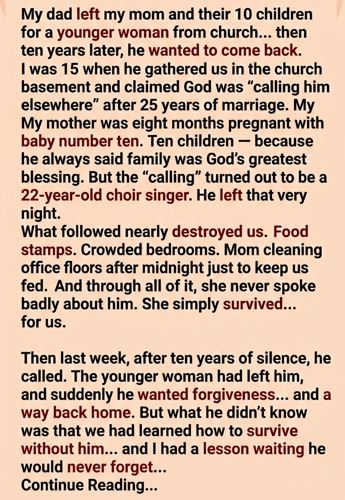
The church basement.
The folding chairs.
Dad standing beneath fluorescent lights pretending sorrow while explaining that God was “leading him down another path.”
I was fifteen.
Old enough to understand betrayal.
Too young to stop it.
Mom sat beside him—pregnant, pale, humiliated.
Eight months from delivering our youngest brother.
Dad talked about faith.
About purpose.
About spiritual growth.
Then two weeks later we learned the truth.
The twenty-two-year-old choir singer.
Suddenly God’s calling had lipstick and soprano solos.
He left that same night.
And life split in two.
Before him.
After him.
After him meant food stamps.
Secondhand shoes.
Three boys sharing one mattress.
Mom scrubbing office buildings after midnight with swollen feet and cracked hands.
I watched her come home smelling like bleach and exhaustion.
Still she never poisoned us against him.
Not once.
If we asked questions, she only said:
“Pain doesn’t improve when we pass it around.”
I didn’t understand that kindness then.
Part of me still doesn’t.
Dad disappeared into his new life.
No birthdays.
No graduations.
No Christmas mornings.
Just silence.
Until now.
Mom finally sat down.
“He wants to see us.”
My youngest sister nearly laughed.
“Us?”
Mom folded her hands.
“She left him.”
The room grew quiet.
Of course she had.
Ten years older now.
No longer the young fantasy he abandoned us for.
I felt anger rise so fast it surprised me.
“And now he remembers his family?”
Mom looked tired.
“He says he’s sorry.”
Sorry.
Such a small word.
My brother Marcus scoffed.
“Was he sorry when Mom worked two jobs?”
Nobody answered.
Because we were all thinking the same thing.
Mom looked toward the window.
“He wants to come home.”
The sentence landed heavily.
Home.
As though home had waited frozen for him.
As though absence created reservation.
I watched Mom carefully.
And something unsettled me.
Not excitement.
Not forgiveness.
Just conflict.
That scared me more.
After everyone went to bed, I found her sitting alone on the porch.
The summer air was warm.
She looked smaller somehow.
“You’re thinking about it.”
She didn’t deny it.
“I don’t know what I’m thinking.”
I sat beside her.
“You don’t owe him anything.”
Her eyes filled softly.
“I know.”
But love is strange.
Especially old love.
It leaves fingerprints even after betrayal.
That frightened me.
Because I knew my mother.
And I knew loneliness.
Then she said something unexpected.
“He sounds broken.”
The words hit me wrong.
Broken?
Where had concern gotten us before?
I took her hand.
“Mom.”
She looked at me.
And for the first time in years, I saw uncertainty.
“He asked if he could visit Sunday.”
I stared.
Sunday.
Church.
Of course.
The irony nearly made me laugh.
And that’s when an idea formed.
Not revenge.
Not cruelty.
Something else.
A lesson.
Sunday arrived hot and bright.
Mom looked nervous.
My siblings buzzed with tension.
Dad arrived exactly at noon.
The sight of him startled me.
He looked older.
Smaller.
Gray replacing confidence.
The man who once filled rooms now seemed careful inside them.
He carried flowers.
Mom accepted them politely.
No hug.
No tears.
Just distance.
He looked around the house awkwardly.
“You fixed the porch.”
Marcus answered flatly.
“Mom did.”
Dad nodded.
“Oh.”
The discomfort grew quickly.
He asked polite questions.
Mentioned church.
Spoke about regret.
And every apology somehow sounded rehearsed.
Then finally he said it.
“I know I don’t deserve it… but I’d like another chance.”
The room went still.
Mom lowered her eyes.
And before she could answer—
I stood.
“Actually,” I said, smiling.
“I planned something.”
Dad looked surprised.
“You did?”
I nodded.
“You wanted family.”
His expression softened.
“Yes.”
“Good.”
I grabbed my keys.
“Then come with me.”
Mom looked confused.
So did everyone else.
But Dad agreed.
The drive lasted twenty minutes.
He tried small talk.
I barely answered.
Finally we parked.
He frowned at the building ahead.
A community center.
“What is this?”
I smiled.
“Family.”
Inside, the gym buzzed with noise.
Children running.
Volunteers organizing food boxes.
Families waiting.
Dad looked lost.
Then people started waving.
My siblings.
All of them.
Every brother.
Every sister.
And at the center—
Mom.
He blinked.
“What’s this?”
I guided him toward a large bulletin board.
Covered with photographs.
Ten years of them.
Graduations.
Birthdays.
Hospital recoveries.
Wedding pictures.
Proms.
Babies.
Mom laughing.
Marcus in uniform.
Our youngest brother receiving his diploma.
Entire lives.
Without him.
Dad stared silently.
His face changed picture by picture.
Then I handed him a folder.
He opened it.
Inside were copies.
Food assistance forms.
Late notices.
Medical bills.
Mom’s overnight work schedules.
School records.
And a final page.
A timeline.
Ten years.
Every event he missed.
His hands began shaking.
“What is this?”
My voice stayed calm.
“You said you wanted another chance.”
He looked confused.
“I do.”
I nodded.
“Then first you need to understand what you’re asking forgiveness to walk into.”
Silence.
The gym noise faded around us.
I pointed toward the photographs.
“You missed all of it.”
His eyes filled.
“I know—”
“No,” I interrupted quietly.
“You remember leaving.”
I swallowed hard.
“But we remember surviving.”
The words hung between us.
He looked toward Mom.
She stood nearby watching silently.
Not bitter.
Not triumphant.
Just honest.
I continued.
“You didn’t leave one wife.”
My voice shook.
“You left twelve people.”
He covered his mouth.
And suddenly—
for the first time—
I saw real grief.
Not self-pity.
Not loneliness.
Recognition.
He looked back at the pictures.
And tears slipped down his face.
“I didn’t know…”
Marcus answered from behind us:
“That’s because you never asked.”
The truth landed heavily.
Dad stood motionless for a long time.
Then he looked at Mom.
And whispered:
“I don’t deserve to come home.”
Mom’s eyes softened.
“No.”
The room held its breath.
Then she added:
“But that doesn’t mean you can’t start somewhere else.”
He looked stunned.
Tears blurred his eyes.
And suddenly I understood something important.
This was never about punishing him.
We didn’t need revenge.
Life had already delivered consequences.
What we needed—
was truth.
Dad never moved back in.
Mom kept her peace.
And slowly, carefully, he began earning something smaller than forgiveness—
access.
Phone calls.
Occasional dinners.
Awkward birthdays.
Not because blood erases damage.
But because accountability matters more than apologies.
Months later, Dad visited again.
He helped set up chairs for one of Mom’s community dinners.
Nothing dramatic.
No speeches.
Just work.
Quiet.
Necessary.
And as I watched him carry tables beside the woman he once abandoned, I realized something.
The lesson I wanted him to learn had never been about guilt.
It was this:
Family is not what you claim when life becomes lonely.
Family is who you stand beside when staying is hardest.
And some homes…
you don’t get to return to.
You learn instead how to knock gently—
and hope the people inside still answer.