The Life-Sized Statue of My Husband Hid a Secret That Could Destroy Our Family
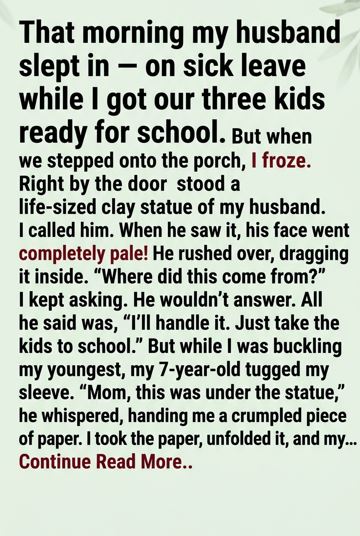
That morning, my husband slept in — on sick leave — while I got our three kids ready for school. But when we stepped onto the porch, I froze. Right by the door stood a life-sized clay statue of my husband. I called him. When he saw it, his face went completely pale! He rushed over, dragging it inside. “Where did this come from?” I kept asking. He wouldn’t answer. All he said was, “I’ll handle it. Just take the kids to school.” But while I was buckling my youngest, my 7-year-old tugged my sleeve. “Mom, this was under the statue,” he whispered, handing me a crumpled piece of paper. I took the paper, unfolded it, and my heart nearly stopped. Written across the top were six words: “YOUR HUSBAND KNOWS WHAT HAPPENED TO ME.”
Beneath those words was a photograph of a young woman I had never seen before. She stood beside my husband, smiling at the camera, her hand resting on his chest. On the back of the photograph was a date from three years earlier, along with an address I recognized immediately. It was the address of an abandoned pottery studio on the other side of town.
My hands began to shake. I had been married to Daniel for twelve years. I knew his habits, his favorite meals, the way he hummed while shaving, and the way he always kissed our children before leaving for work. At least, I thought I knew him.
I looked through the window and saw him staring at the statue as if it were something alive. His lips moved, but I couldn’t hear what he was saying. Then he noticed me watching and quickly pulled the curtains shut.
I drove the children to school, but I barely heard a word they said. My mind kept returning to the photograph. Who was the woman? Why had someone delivered a statue of my husband to our doorstep? And what did Daniel mean when he said he would handle it?
After dropping off the children, I parked outside a small grocery store and called my best friend, Rachel.
“Rachel, I need you to listen to me carefully,” I said. “Have you ever heard Daniel mention a woman named Emily?”
There was a pause.
It was brief, barely two seconds, but I heard it.
“Why are you asking?” she finally replied.
My stomach tightened. “Because someone left a photograph of them together at my house. And there’s a message saying he knows what happened to her.”
Rachel exhaled sharply.
“Listen to me,” she said. “Don’t confront him until you know the whole story.”
“Why would you say that? What do you know?”
“I can’t explain over the phone.”
“Rachel, you have to tell me!”
But she had already hung up.
For several minutes, I sat motionless, staring at my phone. My best friend knew something. That much was certain.
I turned the car around and drove to the address written on the photograph.
The pottery studio stood at the end of a narrow road behind an overgrown iron fence. Most of its windows were boarded up, and weeds had swallowed the cracked walkway. A faded sign above the entrance read Hollow Creek Ceramics.
I pushed the gate open.
Inside, the air smelled of damp earth and old plaster. Broken pottery covered the floor. A workbench stood against the back wall, surrounded by sculpting tools and bags of dried clay.
Then I noticed something that made my breath catch.
On the workbench lay dozens of photographs of my husband.
Daniel at our wedding.
Daniel holding our firstborn in the hospital.
Daniel standing outside our house.
Daniel carrying groceries into the kitchen.
Someone had been watching our family.
I picked up the nearest photograph. On the back, someone had written, “He promised he would tell her.”
Tell me what?
A floorboard creaked behind me.
I spun around.
An elderly man stood in the doorway, holding a wooden walking stick. His clothes were covered in clay dust, and his eyes looked tired but alert.
“You’re Daniel’s wife,” he said.
It wasn’t a question.
“Who are you? Where is Emily?”
The man’s expression softened.
“My name is Thomas. Emily was my daughter.”
I stared at him.
“Was?”
He lowered his eyes. “She disappeared three years ago. The police searched for months, but they never found her. Before she vanished, she told me she was afraid of a man who had promised to protect her.”
“Daniel?”
Thomas nodded slowly.
“He came here often. Emily was an extraordinary sculptor. She made that statue of your husband.”
I felt the room tilt around me.
“Why would she make a statue of Daniel?”
“Because she loved him,” Thomas answered. “And because she believed he had saved her life.”
I shook my head. “That doesn’t make any sense. My husband barely talks about his coworkers, let alone people from his past.”
Thomas walked toward the workbench and pulled out a small envelope.
“Emily left this for you. She told me that if anything happened to her, I should find a way to make sure you received it.”
Inside was a handwritten letter.
Dear Mrs. Carter,
You don’t know me, but I know more about your husband than you might imagine. Three years ago, I discovered something at the company where Daniel worked. Someone was stealing money from elderly clients, changing their records, and making it look as though the money had been withdrawn with their permission.
I found evidence. I thought Daniel would help me expose it.
He promised he would.
But the night I planned to meet him, someone followed me. I managed to hide the documents, but I was never able to deliver them.
If you are reading this, the statue has finally reached you. Look inside its base. The truth is there.
Please don’t trust anyone until you know who has been lying.
Emily.
I read the letter twice.
My husband had never mentioned Emily, the company investigation, or stolen money. But the most frightening part was the final sentence.
Don’t trust anyone.
Not even Rachel?
I thanked Thomas and hurried back to my car. As I drove home, I called Daniel repeatedly. He didn’t answer.
When I arrived, the front door was locked. I used my key and walked inside.
The statue stood in the living room, facing the fireplace.
Daniel was nowhere to be seen.
I approached the statue cautiously. Its base was wider than I had realized, with a thin seam running around the bottom. I knelt and searched until my fingers found a small metal latch hidden beneath the clay.
Inside was a plastic bag containing a USB drive, several bank statements, and a second letter.
The bank statements showed transfers totaling nearly $2 million from accounts belonging to elderly clients. The money had passed through several companies before disappearing into an account bearing a name I recognized.
Rachel Morgan.
My best friend.
The woman who had told me not to confront my husband.
I dropped the papers.
Suddenly, every strange conversation, every unexplained absence, and every time Rachel had insisted that Daniel was a good man seemed to take on a different meaning.
My phone rang.
Daniel’s name appeared on the screen.
“Where are you?” I demanded as soon as I answered.
“Are you home?” he asked.
“I’m standing in front of the statue. I’ve read Emily’s letter. I’ve seen the bank statements. Daniel, what have you done?”
Silence.
Then he whispered, “Please don’t touch anything else. I’m coming home.”
“Tell me the truth!”
“I will. Just promise me you’ll stay inside and lock the doors.”
The call ended.
I stood there, trembling, until a car pulled into the driveway.
But it wasn’t Daniel’s car.
Rachel stepped out.
She walked toward the front door carrying a handbag, wearing the same reassuring smile she had worn at my kitchen table countless times.
I locked the door and backed away.
She knocked gently.
“It’s me,” she called. “Open up. We need to talk.”
I said nothing.
Her smile disappeared.
“I know you’ve found the documents,” she said through the door. “And I know Daniel has told you nothing. But you don’t understand what you’re dealing with.”
I clutched the USB drive.
“Did you steal that money?”
Rachel’s expression changed.
“You should have left the statue alone.”
“Did you hurt Emily?”
She looked toward the street before answering.
“No. I didn’t hurt Emily. Daniel was supposed to make sure she kept quiet, but he couldn’t do it. He was too sentimental.”
“Where is she?”
Rachel’s eyes narrowed.
“She’s alive.”
For a moment, I forgot how to breathe.
“What?”
“She disappeared because she was afraid. Daniel helped her leave town. The statue was supposed to be delivered to you only if something went wrong.”
“Then why did you tell me not to trust him?”
“Because I needed you to believe he was hiding something worse than he was. If you turned against him, he would have nowhere to go. He would have to hand over the evidence.”
I stared at her through the glass.
“You stole millions of dollars from elderly people and tried to frame my husband.”
“I did what I had to do.”
“No,” I said, my voice shaking. “You did what you wanted to do.”
Rachel’s face hardened.
“Give me the USB drive.”
I stepped backward.
“No.”
She struck the door with her palm.
“You have no idea what you’ve just done!”
A second car pulled into the driveway.
Daniel jumped out and ran toward the house. He stopped when he saw Rachel standing on the porch.
For several seconds, neither of them moved.
Then Daniel said, “It’s over, Rachel.”
She laughed bitterly.
“You think you can play the hero now? You knew about the transfers. You signed the reports. You helped me cover everything up.”
My heart sank.
I turned toward my husband.
“Is that true?”
Daniel looked at me, and for the first time in twelve years, he seemed unable to find a single word to say.
Finally, he nodded.
“I knew about the money,” he admitted. “At first, I thought it was a mistake. Then Rachel showed me documents that made it look legal. By the time I realized what she was doing, I had already signed papers I shouldn’t have signed.”
“And Emily?”
“She discovered the truth. I tried to convince her to go to the police, but Rachel threatened her family. I helped Emily disappear because I was afraid Rachel would hurt her.”
“Why didn’t you tell me?”
“Because I was ashamed. And because Rachel threatened to destroy our family if I spoke.”
I looked at the statue, then at the documents in my hands.
“You let me believe I was living with a stranger.”
“I know,” he whispered. “And I have no excuse.”
Rachel suddenly rushed toward me, reaching for the USB drive. Daniel stepped between us, and I stumbled backward, gripping the evidence against my chest.
A police siren sounded in the distance.
Rachel froze.
Daniel had called the police before coming home.
Within minutes, officers surrounded the house. Rachel tried to explain that the documents were stolen and that Daniel was responsible for everything, but the evidence told a different story. The USB drive contained copies of the original records, messages between Rachel and her accomplices, and recordings Emily had made before disappearing.
The officers took Rachel into custody.
Daniel was questioned for hours. He didn’t escape responsibility. He admitted what he had signed, provided investigators with everything he knew, and agreed to cooperate with the case. His decisions had helped Rachel conceal the fraud, and he would have to face the consequences.
That evening, after the children were asleep, I sat across from him at the kitchen table.
“Do you understand what hurts the most?” I asked.
He looked up.
“It isn’t that you made mistakes. It’s that you decided I wasn’t strong enough to know the truth.”
Tears filled his eyes.
“I thought I was protecting you.”
“You were protecting yourself.”
He lowered his head.
I didn’t forgive him that night. I didn’t promise that our marriage would survive. Some betrayals cannot be repaired with one apology, no matter how sincere it sounds.
But I agreed to let the truth come out.
Over the following weeks, investigators traced the stolen money through the accounts Rachel had controlled. Much of it was recovered, and the victims began receiving restitution. Daniel faced legal consequences for his role in concealing the fraud, while the evidence against Rachel grew stronger.
Then, six weeks after the statue appeared on our porch, I received a letter with no return address.
Inside was a photograph of a young woman standing beside the ocean.
On the back were four words:
I’m safe. Thank you.
It was signed Emily.
I cried as I held the photograph. For three years, her father had lived with uncertainty, never knowing whether his daughter was alive. Now, at least, there was hope.
I arranged for Thomas to receive a copy of the letter. He called me the next day, his voice breaking as he thanked me.
The statue remained in our garage for months. I couldn’t bear to look at it, but I couldn’t bring myself to destroy it either. It had brought fear and pain into our home, yet it had also brought the truth into the light.
Eventually, I donated it to a local art center, along with a note explaining that it had been created by a talented artist whose courage helped expose a terrible crime.
As for Daniel and me, we began counseling and learned to speak honestly about the damage his secrecy had caused. Trust did not return overnight. Some days, I wondered whether it would ever return at all.
But I learned something important: love does not mean shielding someone from every consequence. Sometimes, loving your family means demanding the truth, even when the truth changes everything.
One morning, months later, my youngest asked me why the strange clay man had stood on our porch.
I knelt beside him and gently brushed his hair away from his eyes.
“Because someone needed us to see something we weren’t seeing,” I told him.
“What was it?”
I thought about Emily, her father, the stolen money, and the friend who had smiled in my kitchen while hiding a terrible secret.
“The truth,” I answered. “And sometimes, the truth is frightening. But living a lie is worse.”
My son considered that for a moment, then wrapped his arms around me.
I held him tightly.
I still didn’t know what the future would bring for my marriage. But I knew that my children deserved a home built on honesty, and I was determined to give them one.
The statue had looked exactly like my husband. It had his face, his height, and even the small scar above his left eyebrow.
But the greatest shock wasn’t that someone had made a life-sized copy of him.
It was discovering how much of the man I loved I had never truly known.
And the most important lesson I carried away was this: Sometimes, the thing standing right in front of you isn’t the real danger. Sometimes, the real danger is the truth everyone around you is desperately trying to hide.