The Waitress Who Fed a Stranger—and the Shocking Truth Revealed on Camera
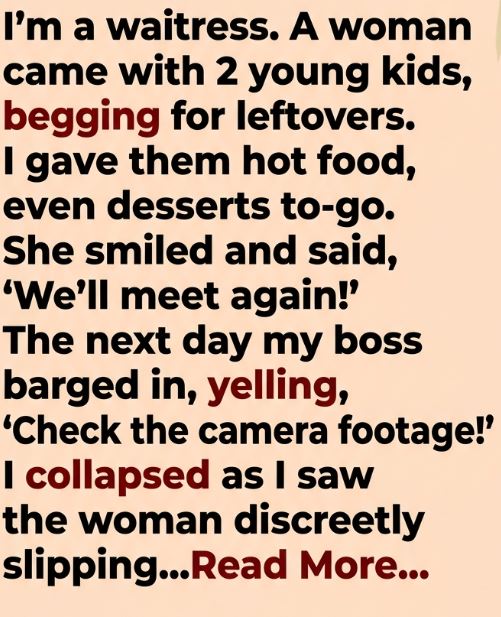
I’m a waitress at a small family restaurant, and most days, people barely notice me. I refill coffee cups, wipe tables, carry heavy trays, and smile even when customers snap their fingers at me as if I’m not a human being. The tips are small, the hours are long, and sometimes I go home with aching feet and barely enough money to cover my bills. But I’ve always believed that even when you have very little, you can still give someone a reason to smile.
That belief was tested one rainy Tuesday afternoon when a woman walked into our restaurant with two young children. The little boy looked about six, and the girl couldn’t have been older than four. Their clothes were thin, their shoes were soaked, and their faces were pale with hunger. The woman stood near the entrance, nervously looking around as if she was afraid someone might order her to leave.
When she finally approached me, her voice trembled.
“Excuse me,” she whispered. “I’m sorry to bother you. I haven’t eaten today, and neither have my children. Do you have any leftovers you might be willing to give us?”
I glanced toward the kitchen. My manager, Richard, was strict about giving away food. At the end of every shift, anything that couldn’t be served again was supposed to be recorded, and employees weren’t allowed to hand it out without permission.
But then the little girl tugged at her mother’s sleeve.
“Mommy, my tummy hurts.”
Those five words broke my heart.
I looked at the children, then at the woman, who was trying desperately not to cry.
“Come sit down,” I told her gently. “Let me see what I can do.”
I brought them to a booth near the back and hurried into the kitchen. There were two untouched plates of chicken and mashed potatoes from canceled orders, along with some fresh bread. I warmed everything up, added vegetables, and carried the meals to their table.
The children stared at the food as if they couldn’t believe it was real.
“Is this really for us?” the little boy asked.
I smiled. “Every bite.”
They began eating so quickly that I gently reminded them to slow down. Their mother watched them with tears streaming down her face.
“I don’t know how to thank you,” she whispered.
“You don’t have to thank me,” I replied. “Just make sure those babies eat.”
After they finished their meals, I packed two slices of chocolate cake, some cookies, and a few extra sandwiches into takeaway containers. I even added two small cartons of milk for the children.
The woman held the bags against her chest as if I had handed her something more precious than food.
Before leaving, she looked directly into my eyes.
“We’ll meet again,” she said softly.
I laughed a little, thinking she was simply being grateful.
“I hope things get better for you,” I told her.
She smiled, but there was something unusual about that smile—something I couldn’t quite understand.
Then she took her children’s hands and walked out into the rain.
I returned to work, thinking I had done one small good thing in a difficult world.
I had no idea that by the following morning, my entire life would change.
The next day, I arrived at the restaurant earlier than usual. I had barely tied my apron when Richard, my manager, stormed out of his office holding a stack of papers.
“Everybody stop what you’re doing!” he shouted.
The kitchen fell silent. Two servers froze beside the coffee machine, and the cook lowered his spatula.
Richard marched toward me, his face red with anger.
“You!” he barked, pointing directly at me. “Get in my office. Now!”
My stomach tightened.
“Did I do something wrong?” I asked.
Instead of answering, he slammed his hand against the counter.
“Check the camera footage!” he yelled at the assistant manager. “I want everyone to see exactly what happened yesterday!”
My hands began to shake.
I followed them into the small office, where a security monitor showed recordings from the dining room. Richard rewound the footage to the previous afternoon and pointed at the screen.
There I was, bringing food to the woman and her children.
Then he fast-forwarded.
The woman stood up, gathered the takeaway bags, and glanced around the restaurant. Before walking out, she moved close to the service counter and discreetly slipped something beneath the edge of a decorative napkin holder.
Richard paused the video.
“There!” he shouted. “Look at that!”
I stared at the screen, confused.
“What did she take?” I whispered.
Richard turned toward me with a furious expression.
“Take? You’re asking what she took? She left something behind, and now the owner is demanding answers. Do you have any idea what this means for this restaurant?”
He played the footage again, zooming in on the woman’s hand.
I could see her sliding a small, folded envelope beneath the napkin holder.
Then Richard opened a drawer and pulled out the actual envelope.
My heart began pounding.
He tore it open and removed a handwritten note.
“What is this supposed to be?” he demanded.
I shook my head. “I don’t know. I swear, I’ve never seen that before.”
Richard looked at the note, then at me.
“Read it.”
My fingers trembled as I took the paper.
There were only a few sentences written inside.
To the waitress who fed my children when we had nothing,
Yesterday, you saw a hungry mother and two children. You didn’t see a problem, an inconvenience, or a waste of food. You saw human beings.
I will never forget that.
Please let the owner know that I would like to speak with you personally.
We promised we would meet again.
At the bottom was a name, followed by a telephone number.
I looked up at Richard, still not understanding.
“Who is she?” I asked.
Richard swallowed hard.
“That’s what I want to know. Because the restaurant owner received a phone call this morning from a woman who claims she has an important reason to meet the waitress who helped her yesterday.”
He paused.
“And apparently, she knows the owner personally.”
Before I could respond, the office telephone rang.
Richard answered it, and his expression changed almost immediately.
“Yes, sir. She’s here.”
He listened for a few seconds, then slowly handed me the phone.
“The owner wants to speak with you.”
I pressed the receiver to my ear.
“Hello?”
A calm female voice answered.
“Good morning. My name is Eleanor Whitmore. I believe you helped me and my children yesterday.”
I remembered the woman’s face immediately.
“Yes, ma’am,” I said. “I hope your children are doing better.”
There was a brief silence.
“They are,” she replied. “And I want you to know that what you did yesterday meant more to me than you can imagine.”
I smiled nervously.
“I was just giving you some food.”
“No,” she said gently. “You did something much more important. You helped me when I was afraid, exhausted, and beginning to believe that nobody in the world cared whether my children went hungry.”
Her voice caught.
“I need you to meet me today. There are things you deserve to know.”
Before I could ask what she meant, she gave me a time and told me to meet her at the restaurant at noon.
Then she hung up.
I stood there holding the telephone, completely bewildered.
Richard crossed his arms.
“You’d better hope you haven’t gotten us into some kind of trouble.”
I didn’t answer.
For the next three hours, I could barely concentrate. I kept thinking about the children, wondering whether they had a safe place to sleep and whether their mother had found something to eat that morning.
At precisely noon, a black luxury car pulled into the parking lot.
A driver stepped out and opened the rear door.
The same woman climbed out.
But this time, she looked nothing like the frightened mother I had met the day before.
She wore an elegant cream-colored coat, carried a leather handbag, and walked with quiet confidence. Her hair was neatly styled, and a man in a dark suit followed her into the restaurant carrying a briefcase.
Richard nearly dropped the coffee pot when he saw her.
The woman walked straight toward me.
“Thank you for meeting me,” she said.
I stared at her in disbelief.
“Your children? Are they with you?”
She smiled warmly.
“They’re safe with my sister.”
Then she glanced toward Richard.
“Is the owner here?”
Richard hurried forward.
“Yes, ma’am. I’m Richard, the manager. We were expecting you.”
She nodded.
“Good. Then I think we should all sit down.”
We gathered at a table near the window. The woman placed her handbag beside her and looked at me.
“My name is Eleanor Whitmore,” she began. “My late husband founded Whitmore Hospitality Group. We own several hotels and restaurants across the state.”
Richard’s face went pale.
I had heard of Whitmore Hospitality Group. It was a major company whose name appeared on expensive hotels and upscale dining establishments.
But I couldn’t understand what that had to do with me.
Eleanor continued.
“Three months ago, my husband passed away. After his death, I discovered that I had spent so many years surrounded by people who wanted something from me that I no longer knew whom I could trust.”
She folded her hands on the table.
“So I decided to do something unusual. I left my usual surroundings, dressed simply, and spent a few days seeing how ordinary people treated someone they believed had nothing to offer them.”
I listened silently.
“Yesterday, I came into this restaurant with my children. I was genuinely hungry, frightened, and exhausted. I wanted to see whether anyone would show us kindness without asking who we were.”
Her eyes softened.
“You did.”
I shook my head.
“I didn’t know who you were. I still don’t understand why you’re telling me this.”
“Because that is precisely why,” she replied.
Then she turned toward Richard.
“I watched the security footage. I saw how she prepared the food, made sure the children were comfortable, and packed extra meals for us.”
Richard shifted uncomfortably in his chair.
Eleanor’s voice became firmer.
“I also heard what happened this morning. You shouted at her in front of the staff before you even knew what was in that envelope.”
Richard opened his mouth, but she raised a hand.
“Please don’t interrupt me.”
The room fell silent.
She reached into her handbag and removed a second envelope.
“This contains a formal letter from my legal team. Yesterday’s visit was not an inspection arranged by your company, and I had no intention of causing trouble for your employees. The note I left was simply an invitation to speak with this young woman.”
She turned back to me.
“But there is something else I want to offer you.”
My heart began racing.
Eleanor slid a folder across the table.
“I understand that you work long hours here. I understand that you earn very little and that you’ve been doing this job while trying to support yourself. I also understand that you’ve wanted to study hospitality management but couldn’t afford the tuition.”
I stared at her.
How could she possibly know that?
She explained that, after leaving the restaurant, she had spoken briefly with the owner, who confirmed that I had been a reliable employee for years and had once asked about opportunities for advancement.
Then she opened the folder.
Inside was a scholarship offer covering my hospitality management education, along with a paid training position at one of her company’s hotels.
I covered my mouth with my hand.
“I can’t accept this,” I whispered. “I only gave your children something to eat.”
Eleanor reached across the table and gently held my hand.
“That’s exactly why I want you to accept it. You didn’t help me because you expected a reward. You helped because two children were hungry.”
Tears blurred my vision.
For years, I had worked double shifts, skipped meals to save money, and wondered whether I would ever escape the cycle of barely surviving from one paycheck to the next.
Now someone was offering me a chance I had never imagined possible.
But Eleanor wasn’t finished.
She turned toward Richard one last time.
“One more thing. I want you to understand something about leadership. A business can measure its profits, count its inventory, and review its security footage. But none of those things can measure the character of the people who work there.”
Richard lowered his eyes.
“I was trying to protect the restaurant,” he muttered.
“Protecting a business does not require humiliating an employee for showing compassion,” Eleanor replied. “If food policies need to change, change them. If employees need clearer guidance, give it to them. But never make someone feel ashamed for caring about another human being.”
Then she stood up.
“I’ll be speaking with the owner about establishing a policy that allows employees to provide safe, unsold meals to people in need. No one should have to fear losing their job simply because they wanted to help a hungry family.”
She turned to me and smiled.
“And as for you, I hope you’ll give yourself the same kindness you gave my children yesterday. Accept the opportunity. Build the life you’ve been working so hard for.”
I couldn’t speak.
All I could do was cry and thank her.
Before leaving, Eleanor hugged me.
Then she whispered something I’ll never forget.
“When my children are older, I want them to remember that the first person who helped us when we were struggling wasn’t someone wearing an expensive suit. It was a waitress who had every reason to worry about her own problems but still made room for ours.”
She walked out of the restaurant, leaving me with a folder that could change my future.
Richard didn’t say another word to me that afternoon.
A week later, I began my training program. The scholarship allowed me to attend classes while earning enough money to pay my bills. I studied hard, learned how to manage a kitchen, trained with experienced hospitality professionals, and discovered that I was capable of far more than I had ever believed.
Two years later, I graduated with honors.
I eventually became the manager of a restaurant within Eleanor’s company. One of the first things I did was establish a program that allowed staff to provide safe, unsold meals to people who needed them, following proper food-safety procedures.
We partnered with local shelters, community groups, and food banks to make sure the meals reached families who needed them most.
I never forgot the two children who had sat in that booth, eating as if every bite were a gift.
And every time a frightened parent came through our doors asking for help, I remembered their mother’s tears.
Years passed, and one afternoon, I received an invitation to a special company event.
Eleanor was there, standing beside two teenagers.
For a moment, I didn’t recognize them.
Then the boy stepped forward and smiled.
“You’re the waitress who gave us chicken and chocolate cake, aren’t you?”
I felt tears gather in my eyes.
“Yes,” I whispered. “I remember you.”
He introduced himself as Daniel, and his younger sister as Lily. Their mother stood behind them, smiling proudly.
Daniel told me that his mother had kept the original takeaway receipt from that day, along with a photograph of the restaurant.
“She told us that when we had almost nothing, a stranger treated us like we mattered,” he said. “She wanted us to grow up remembering that.”
Lily reached into her handbag and handed me a small envelope.
Inside was a photograph of the two children from the day they visited the restaurant. On the back, their mother had written a message.
You fed my children when they were hungry. You gave me hope when I was close to losing it. We promised we would meet again, and today I want you to know that your kindness became part of our family’s story.
I pressed the photograph against my chest and cried.
Eleanor stood beside me.
“You see?” she said softly. “Kindness doesn’t always return the way we expect. Sometimes it comes back as an opportunity. Sometimes it comes back as a memory. And sometimes it becomes something that keeps helping people long after the original moment has passed.”
That evening, I returned home and placed the photograph in a frame beside my front door.
Whenever life becomes difficult, I look at those two smiling children and remember the day I nearly let fear stop me from doing what I believed was right.
I had worried about breaking a restaurant rule. I had worried about losing my job. I had worried about what my manager might say.
But the truth was simple.
I could replace a few meals.
I couldn’t replace the chance to make a hungry child feel safe.
And I learned something that changed the way I lived my life forever: you never know what someone is carrying when they walk through your door, and you never know how far a small act of kindness might travel.
Sometimes, the person you help today will never be able to repay you.
Sometimes, they will remember you for the rest of their life.
And sometimes, the moment you think is nothing more than an ordinary afternoon becomes the moment that changes everything.
That rainy Tuesday, I thought I was simply feeding a mother and her two children.
I never imagined that the next day, a security camera would reveal an envelope, a powerful woman would return, and my entire future would begin to change.
But the greatest reward wasn’t the scholarship, the new job, or the opportunities that followed.
It was knowing that when a family needed help, I didn’t turn away.
And if I could go back to that afternoon, knowing everything I know now, I would still warm those meals, pack those sandwiches, add those slices of chocolate cake, and smile at the frightened mother standing in front of me.
Because kindness is never wasted.
Sometimes, it is the beginning of a story none of us could have predicted.